
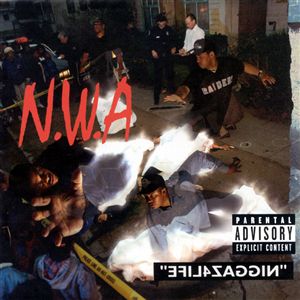
On May 28, 1991, N.W.A released Niggaz4Life, the album also known by its backwards-cover title, Efil4zaggin. It was the group’s second and final studio album — a hard-edged follow-up to Straight Outta Compton — and one of the most controversial rap records to ever reach the top of the American album chart. Apple Music lists the album with a May 28, 1991 release date, 18 tracks and a 55-minute runtime on Priority Records.
By the time the album arrived, N.W.A was no longer quite the same group that had detonated Straight Outta Compton. Ice Cube had left in 1989 after royalty disputes, Arabian Prince was gone, and the remaining core of Eazy-E, Dr. Dre, MC Ren and DJ Yella was working under the weight of expectation, internal tension and outside scrutiny. Straight Outta Compton had made N.W.A famous, feared and condemned — and Efil4zaggin showed what was left after that first explosion.
Chart history and the SoundScan shift
The album’s chart performance was historic. Efil4zaggin debuted at No. 2 on the Billboard 200 and climbed to No. 1 in its second week. Contemporary chart histories and music databases identify it as the first hardcore or gangsta rap album to reach the top of the chart.
The timing mattered. Just days before the album’s release, Billboard began using Nielsen SoundScan data for its album chart, replacing a more subjective reporting system with electronically monitored point-of-sale information. That change gave a clearer picture of what people were actually buying, and rap, country and metal suddenly looked much bigger on paper than the industry had often admitted. In that sense, Efil4zaggin was not just a successful rap album — it was proof that N.W.A’s audience was already massive. The mainstream did not create that audience; SoundScan helped expose it.
Sound and influence
Musically, Efil4zaggin is darker and more polished than Straight Outta Compton. Dr. Dre and DJ Yella pushed the production into heavier, funkier and more cinematic territory, with tracks like “Alwayz Into Somethin’,” “Appetite for Destruction” and “Approach to Danger” pointing toward the West Coast sound that would soon dominate the early 1990s. The album kept the group’s blunt-force aggression, but the beats were deeper, slower and more atmospheric — a bridge between N.W.A’s late-’80s attack and the G-funk era that would fully arrive with Dre’s The Chronic.
Controversy and consequences
No honest look at Efil4zaggin can separate the music from the backlash. The album was built to provoke, and it did. Its violent imagery, explicit sexual content and misogyny drew intense criticism from politicians, moral watchdogs, critics and activists. Some listeners heard it as exaggerated street theater; others heard it as corrosive and indefensible. Both reactions became part of the album’s history.
The controversy went beyond bad reviews. In Britain, police seized thousands of copies under the country’s Obscene Publications Act. The case eventually went to court, where the album was played during the hearing. In November 1991, British magistrates ruled that the record did not violate obscenity laws and ordered police to pay court costs. That legal fight helped cement the album’s reputation as one of rap’s most combustible releases and raised the ongoing question: where does documentation end and exploitation begin?
Lineup changes and legacy
The absence of Ice Cube was impossible to ignore. His writing had been central to Straight Outta Compton, and the group’s feud with him ran through the album’s atmosphere. N.W.A’s 1990 EP 100 Miles and Runnin’ had already taken shots at Cube, and the tension carried into the Efil4zaggin era — a split that would soon become one of hip-hop’s most famous breakups.
Still, Efil4zaggin stands as more than a feud record or controversy object. It captured N.W.A at a strange, unstable peak: commercially bigger than ever, creatively aggressive, politically radioactive and already close to collapse. The group would not release another studio album. Dr. Dre would leave Ruthless, Death Row would rise, and West Coast rap would enter a new chapter almost immediately.
That is what makes the album so important in hindsight. It sits at the end of one era and the beginning of another. Straight Outta Compton kicked down the door; Efil4zaggin showed that the industry could no longer pretend the room was empty.
On May 28, 1991, N.W.A released a record that reached No. 1, drew police attention overseas, deepened hip-hop’s censorship battles and helped reveal the commercial force of rap in the SoundScan age. It remains a difficult album, an influential album and a deeply uncomfortable artifact of its moment — a tension that helps explain why it still matters.
Note: This article is a retrospective look at the album and its context.