
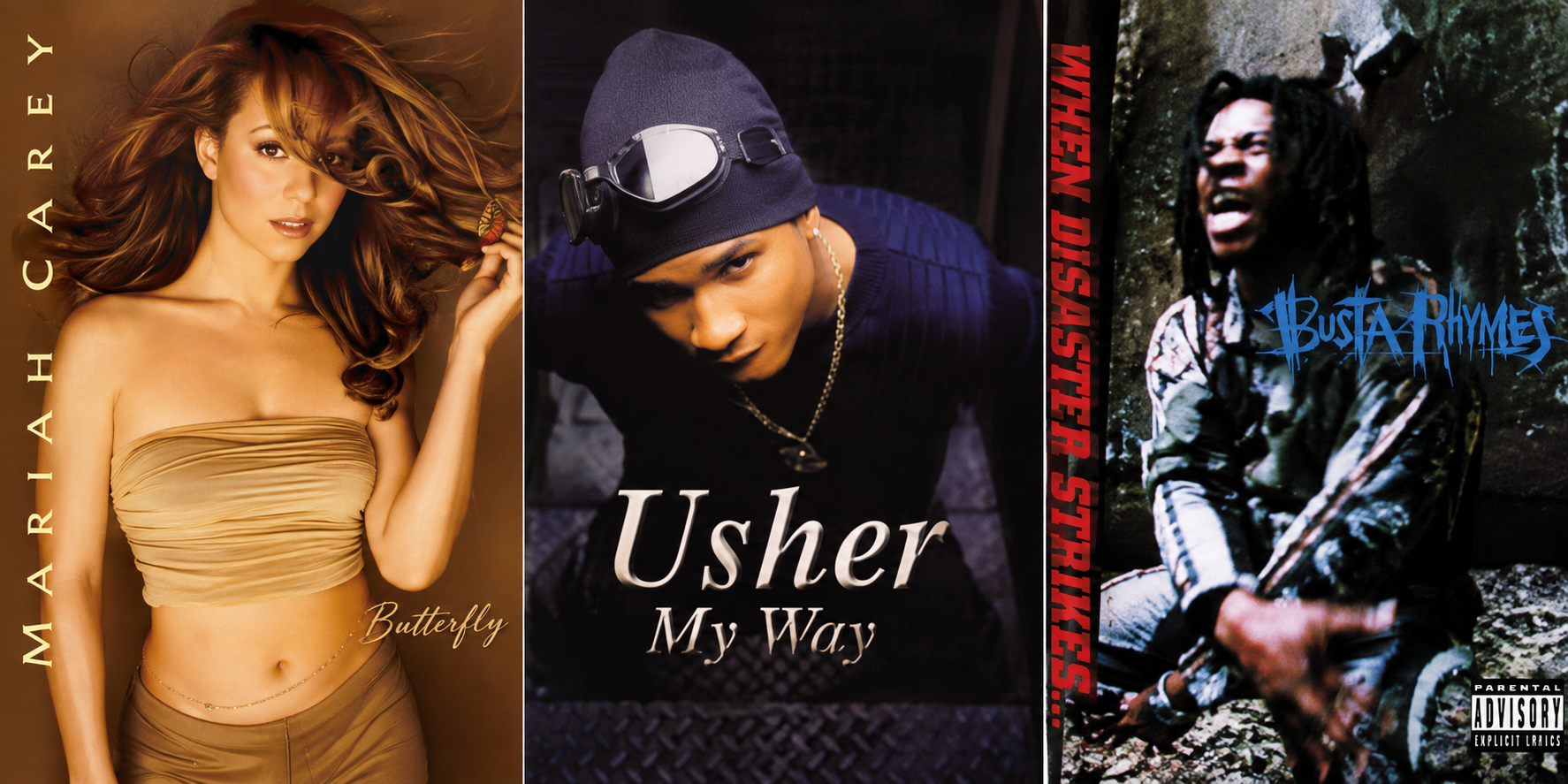
September 16, 1997 produced one of those unusually strong release days that becomes more interesting with distance.
Mariah Carey released Butterfly. Usher released My Way. Busta Rhymes released When Disaster Strikes....
Three artists, three very different records, and three very different stages of their careers.
Carey was already one of the biggest recording artists in the world, but Butterfly represented a significant change in how she approached pop, R&B and hip-hop. Usher was still a young singer trying to establish himself after a relatively quiet debut. Busta Rhymes had already built a reputation as one of hip-hop's most recognizable personalities, but was still proving that he could turn that personality into a lasting solo career.
Looking back, the albums tell three separate stories about where popular music was heading as the 1990s approached their final years.
Mariah Carey steps further into hip-hop
Mariah Carey entered 1997 with something most artists spend an entire career trying to achieve: an established place at the top of pop music.
Her first album, Mariah Carey, had arrived in 1990 and produced four No. 1 singles. Emotions, Music Box and Daydream followed, with the latter two becoming enormous commercial successes. By the middle of the decade, Carey had become almost synonymous with the big pop ballad and technically demanding vocal performance.
But there had been another side to her musical interests for years.
Carey had already begun incorporating hip-hop more openly into her work on 1995's Daydream. The remix of "Fantasy," featuring Ol' Dirty Bastard, was particularly important. Instead of treating the rapper as an accessory to a conventional pop single, Carey and her collaborators built the remix around the contrast between her melodic vocal and ODB's completely different presence.
Butterfly took that relationship much further.
Released on September 16, the album featured collaborations with Sean "Puffy" Combs, Q-Tip, Missy Elliott and Bone Thugs-n-Harmony, among others. Apple Music describes the record as a continuation of Carey's move toward hip-hop that had begun with Daydream, while also highlighting the contrast between her powerful voice and the more restrained production surrounding it.
The change was immediately apparent with "Honey."
The song was produced by Sean Combs, Stevie J and the Hitmen, and it gave Carey a much more rhythm-driven sound than many of her earlier hits. It also came with a dramatically different visual presentation. The video placed Carey in a James Bond-inspired action story involving spies, helicopters and an elaborate escape, rather than the traditional performance-centered videos that had often accompanied her earlier ballads.
And the gamble worked.
"Honey" debuted at No. 1 on the Billboard Hot 100, becoming Carey's 12th No. 1 single. Contemporary Billboard reporting noted that the achievement moved Carey ahead of Madonna and Whitney Houston for the most No. 1 singles among solo female artists at the time.
Butterfly itself debuted at No. 1 on the Billboard 200, selling more than 235,000 copies in its first week.
The album's importance, however, was not simply that another Mariah Carey record had topped the chart.
Carey was changing the balance between the genres.
She was no longer approaching hip-hop as an occasional stylistic ingredient. The collaborations were becoming part of the sound and identity of her music. "The Roof," for example, drew on a sample of Mobb Deep's "Shook Ones Part II" and paired Carey with the world of East Coast hip-hop. "Breakdown" brought Bone Thugs-n-Harmony into the album. The title track was an emotionally exposed ballad rather than a vocal showcase.
That combination became one of the album's defining characteristics.
The Washington Post later described Butterfly as a turning point in Carey's career and argued that the album also helped change pop music by placing her more firmly within hip-hop culture.
There was a personal dimension, too.
Carey had separated from Sony Music chairman Tommy Mottola, whom she had married in 1993. The circumstances surrounding that relationship and its eventual end became part of the public conversation around Butterfly. Carey herself described the album as more personal than her earlier work, saying that she was writing more directly from her own experiences rather than imagining other people's situations.
The result was an album that sounded like an artist who had decided she no longer needed to remain inside the role that had made her famous.
That distinction is important.
Carey did not abandon pop on Butterfly. She expanded what her version of pop could contain.
Usher gets his breakthrough
Usher Raymond was in a very different position.
When My Way arrived, he was only 18 years old.
His self-titled debut had been released in 1994 when he was just 15. It had introduced him as a young R&B singer, but it had not made him a household name. The three-year gap between the albums gave Usher time to mature, and My Way was where the public began to hear the difference.
The person most responsible for the album's sound was Jermaine Dupri.
Dupri had already established himself as a producer and songwriter with a strong understanding of contemporary R&B and hip-hop. His work with Kris Kross and other artists had demonstrated his ability to make R&B records that could cross into mainstream radio without losing their rhythmic foundation.
For Usher, it was the right partnership.
The first single, "You Make Me Wanna...", was written by Usher, Dupri and Manuel Seal and produced by Dupri and Seal. The song dealt with a relationship that had become complicated, but its presentation was deliberately conversational. Usher wasn't trying to sound like an older singer. He sounded young, confident and increasingly comfortable with the idea of being an adult R&B artist.
The song became his breakthrough.
It reached No. 2 on the Billboard Hot 100 and gave Usher his first major crossover hit. It also earned him a Grammy nomination for Best Male R&B Vocal Performance.
The album itself debuted at No. 15 on the Billboard 200 with 66,000 copies sold in its opening week. That wasn't a blockbuster opening, but the record continued to build momentum and eventually reached No. 4. More importantly, it climbed to No. 1 on Billboard's Top R&B/Hip-Hop Albums chart and remained there for three consecutive weeks.
Then came "Nice & Slow."
The second single gave Usher his first No. 1 on the Billboard Hot 100 and demonstrated that his appeal wasn't dependent on the upbeat production of "You Make Me Wanna..." He could carry a slower, more intimate record and still command mainstream radio.
The title track, "My Way," followed and reached No. 2 on the Hot 100.
Three singles, three different sides of the same artist.
That was the real achievement of My Way. Usher wasn't simply having a hit. He was beginning to establish the musical identity that would carry him through the next decade.
It is difficult to hear My Way today without knowing what came afterward. Usher would eventually release 8701 in 2001 and Confessions in 2004, becoming one of the defining R&B stars of the 2000s.
But none of that was guaranteed in September 1997.
At that point, My Way was the record that demonstrated he had grown beyond the teenage singer introduced three years earlier.
Busta Rhymes turns chaos into a career
Busta Rhymes had perhaps the most distinctive personality of the three.
Born Trevor Smith Jr., he had become known through Leaders of the New School, the Long Island hip-hop group that emerged from the Native Tongues collective. His appearance on A Tribe Called Quest's "Scenario" became one of the most memorable guest verses of the early 1990s, largely because of his explosive delivery.
By the time he released his first solo album, The Coming, in 1996, audiences already knew what Busta brought to a record.
The question was whether that energy could sustain an entire solo career.
When Disaster Strikes... was the answer.
Released on September 16, the album debuted at No. 3 on the Billboard 200 after selling approximately 165,000 copies in its first week. It also reached No. 1 on Billboard's Top R&B Albums chart and was certified platinum by the RIAA within weeks of its release.
The album's lead single, "Put Your Hands Where My Eyes Could See," was unlike much of what was dominating rap radio.
The production was relatively restrained, giving Busta room to play with his timing and delivery rather than simply overwhelming the beat. The song also sampled Seals & Crofts' "Sweet Green Fields," an unexpected choice that became part of its distinctive sound.
Then came the video.
Directed by Hype Williams, the video borrowed heavily from Coming to America, with Busta appearing in elaborate costumes and surrounded by deliberately extravagant imagery. It was funny, strange, theatrical and impossible to mistake for another artist's video.
That mattered in 1997 because MTV was still an enormous force in breaking records.
Busta understood that a music video did not have to simply illustrate a song. It could become part of the song's identity.
The Washington Post's contemporary review of When Disaster Strikes... singled out the album's visual and musical imagination, pointing to "Put Your Hands Where My Eyes Could See," its Coming to America imagery and the record's use of samples ranging from Seals & Crofts to KC and the Sunshine Band and Al Green.
The album also demonstrated that Busta's musical range was considerably wider than his loudest performances suggested.
"One," featuring Erykah Badu, moved in a completely different direction. Built around Stevie Wonder's "Love's in Need of Love Today," it gave Busta space to address Black identity, relationships and community rather than simply delivering another high-energy rap performance. The collaboration also connected him to the neo-soul movement that was beginning to gain momentum at the same time.
That contrast is important when looking at Busta's career.
His personality was enormous, but the music underneath it was more carefully constructed than the image sometimes suggested.
When Disaster Strikes... proved that.
Three records, three career turning points
The interesting thing about September 16, 1997 isn't that these three albums somehow formed one musical movement.
They didn't.
What makes the date worth remembering is what each album represented for its artist.
For Mariah Carey, Butterfly was a deliberate expansion of an already enormous pop career. She had the commercial power to experiment and used it to move deeper into hip-hop and contemporary R&B. "Honey" immediately demonstrated that the change wasn't going to hurt her ability to reach No. 1.
For Usher, My Way was the breakthrough. His first album had introduced him, but this was the record that established his voice, his relationship with Jermaine Dupri and his ability to make songs that worked both within R&B and on mainstream pop radio.
For Busta Rhymes, When Disaster Strikes... was the confirmation that the personality audiences had noticed in Leaders of the New School and "Scenario" could sustain a solo career. The album's commercial performance and its visually ambitious singles established him as something more than a memorable guest or eccentric performer.
And there is a broader story connecting all three.
In the late 1990s, the lines between R&B, hip-hop and mainstream pop were becoming increasingly porous. Producers moved between genres. Rappers appeared on pop records. R&B singers incorporated hip-hop production. Music videos became increasingly important to an artist's identity.
These three albums each approached that shift from a different direction.
Carey was already at the top and moving toward hip-hop.
Usher was entering the mainstream through contemporary R&B.
Busta was bringing hip-hop's eccentricity and visual imagination further into mainstream culture.
That made September 16, 1997 an unusually revealing day in hindsight.
At the time, listeners simply had three new albums to choose from.
Nearly three decades later, the significance is easier to see.
Butterfly became one of the defining albums of Mariah Carey's career. My Way established the foundation for Usher's rise into the upper tier of 2000s R&B. When Disaster Strikes... cemented Busta Rhymes as one of hip-hop's most distinctive solo artists.
Three records released on the same day.
Three very different careers moving forward.
And a pretty remarkable snapshot of where popular music stood in 1997.